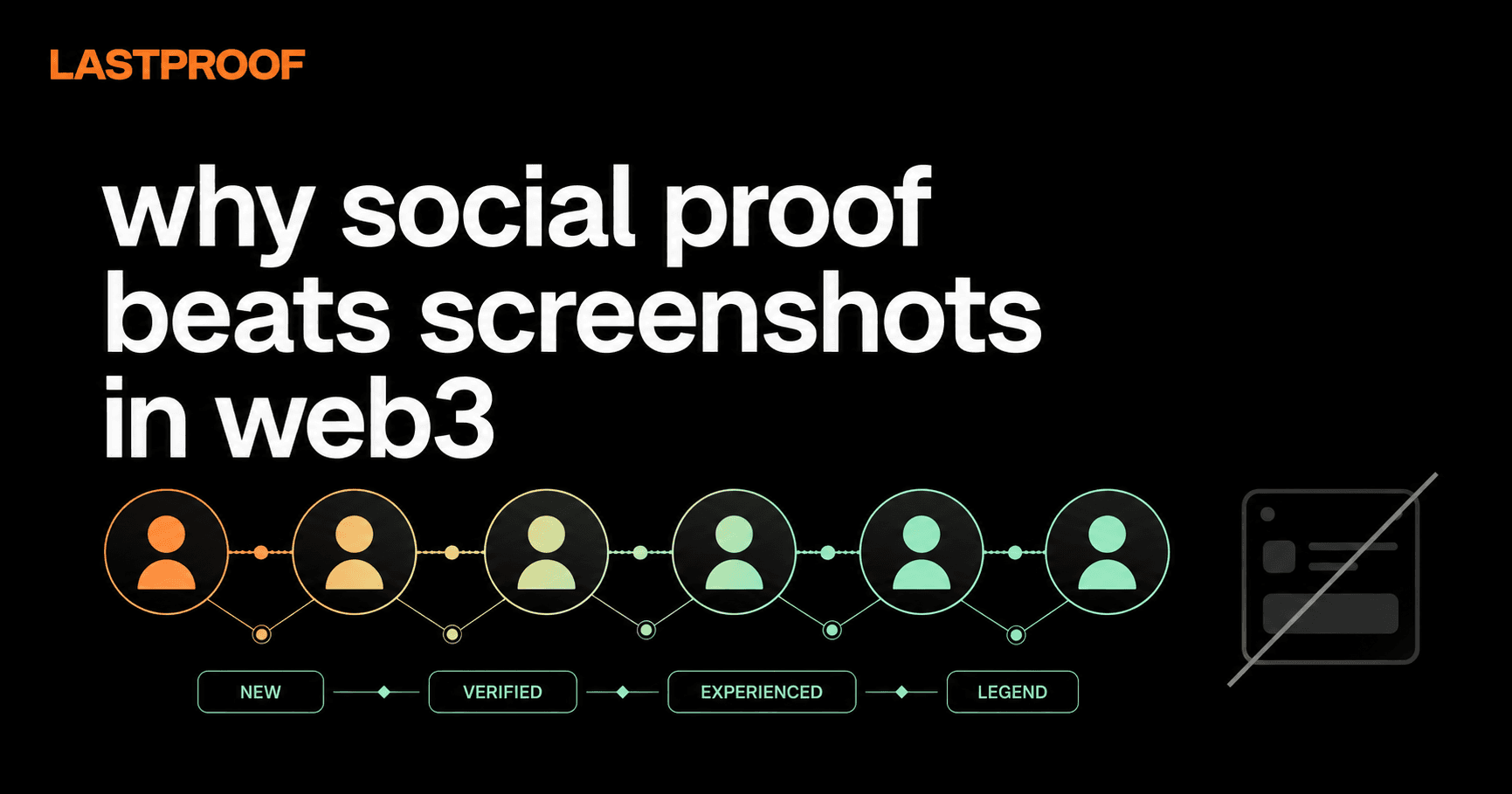
why social proof beats screenshots in web3
the only durable way for an anon crypto operator to prove they're legit in 2026 is a public network of other operators who have publicly backed them. screenshots get fabricated. referrals get gamed. private DMs vouching for someone leave no trail. a visible, time-stamped, removable list of named operators who have gone on the record to vouch is structural proof — and it scales in a way no individual claim ever can. this post explains why the network effect works when nothing else does, and how lastproof's chad loop ships it.
the screenshots problem
every anon crypto operator looking for work in 2026 has the same problem and reaches for the same broken solution.
the problem: nobody knows who you are. you're a handle. you have no resume because there are no resumes for telegram mods or shillers or memecoin community managers. the only way a project dev can hire you is if they trust you, and the only way they can trust you is if you can show them something — anything — that suggests you've done the work before and didn't ghost.
the broken solution: screenshots. screenshots of past dms with founders. screenshots of telegram channels you ran. screenshots of payment confirmations. screenshots of charts during your coverage windows. screenshots of testimonials from project devs.
every one of these is fabricable. every one of them is fabricated daily. there are entire telegram groups where operators trade templates for fake testimonial screenshots. the going rate to commission a fully fabricated track record is around $50 if you know where to ask. and even when the screenshots are real, the project dev on the other end can't verify them — they have to take the operator's word, which is the entire problem they were trying to solve.
screenshots lie. every anon sounds the same. that's the floor. it's why hiring an anon operator in crypto in 2026 still feels like rolling dice even when the operator looks decent on paper.
referrals don't fix this either. referrals just push the trust problem one degree out — now you're trusting whoever vouched for the operator, and that person is also probably an anon. unless the referral comes from a project dev who can be reached and asked directly (rare, and rarer still that they answer dms about a former hire), referrals are just first-degree screenshots wrapped in a friendlier voice.
the floor is broken. you need something else.
why social proof scales when narrative doesn't
here's the structural difference. a screenshot is a narrative claim — "this thing happened, and i'm telling you it happened." a public, persistent, time-stamped vouch from another named operator is a structural claim — "i, this specific named entity with my own reputation on the line, have publicly committed to backing this person, and you can verify the commitment by clicking my profile and seeing them in my list."
the difference is who pays the cost of the lie.
if a screenshot is fabricated, the operator showing it pays nothing. it costs them nothing to fake, costs them nothing to send, and if they're caught, they ghost and start over with a new handle. there's no consequence loop.
if a public vouch is fake, the operator who vouched pays the cost. they put their own profile, their own tier badge, their own visible track record on the line by associating with someone. when the person they vouched for screws up, every dev looking at the voucher's profile sees them in the list. that's social cost. it forces selectivity.
this is the foundation of how reputation works in any other industry. linkedin endorsements work this way (poorly, but the structure is right). academic citations work this way. reddit moderator chains work this way. the entire credit-rating system works this way. you don't trust an entity because they tell you they're trustworthy. you trust them because the network of named entities around them have publicly committed to backing them, and those entities have something to lose if they're wrong.
crypto has not had this primitive — until now.
the chad loop, explained
here's the feature, in operator terms.
every active operator profile on lastproof has a + ADD CHAD button and a Chad Army — an avatar grid of the operators they've connected with, displayed publicly underneath their tier bar.
how it works: click + ADD CHAD on someone's profile to send them an ask. the ask lands in their dashboard under Pending Asks. they can accept, deny, or ignore. if they accept, they appear in your Chad Army — visible on every public render of your profile, click-through to their own profile, time-stamped to the date they accepted.
every newly-published operator profile starts with one default chad: @lastshiftfounder. tom-from-myspace pattern. the chad management card on your dashboard is populated from day one, the feature reads as self-explanatory the moment you see it, and you can remove the default any time. if you re-add later, it goes through the normal ask flow.
free profiles don't participate. they can't send asks, can't receive asks, don't appear in any army. asks targeting a free profile silently fail and the modal nudges the asker to upgrade. the chad loop is a paid feature — included in the $10/month profile (free forever for the first 5,000 operators), discounted 40% if you pay in $LASTSHFT.
if a chad lapses to free, they hide from your army automatically until they reactivate. the row stays in the database, just stays invisible. deny hard-deletes the relationship, so re-asks are possible later — there's no permanent block, just a one-strike-per-attempt design.
the chad loop visible to a viewer of your profile: avatar grid, tier badges of each chad, click-through to each chad's own profile and their own chad army. depth one click down. anyone vetting you can audit the entire chain.
why directional, not mutual (the design rationale)
here's the part most people don't immediately get: when someone accepts your ask, they appear in your army — but you do not appear in theirs.
this is deliberate. the model is one-direction, like instagram's private profile follow. for two operators to appear in each other's armies, both must send their own ask and both must accept. each direction is its own row, its own decision.
mutuality is a trap. if accepting an ask automatically added the asker to the accepter's army, the entire system collapses into mutual back-scratching within a week. operators trade accepts. armies bloat. the signal that someone is "in your army" stops meaning "i vouched for them" and starts meaning "we agreed to inflate each other's numbers." this is exactly what happened to linkedin endorsements, and exactly why nobody trusts them anymore.
directional asks force the question to be asked separately each direction. a chad in your army means you vouched for them. it does not mean they negotiated with you to do so, and it does not mean they are obligated to vouch back. some of the most useful arrangements are asymmetric — a tier-1 NEW operator backs a LEGEND because the LEGEND deserves the visibility and the NEW knows it; the LEGEND has no reason to vouch back, and that's fine. the system works.
mutuality also breaks the math. when armies are bidirectional by default, the chad count of an operator becomes a near-perfect proxy for "how social are they" rather than "how many people have publicly bet on them." asymmetry restores the signal.
what a network of chads actually proves
here's what someone vetting you sees when they click your profile in 2026:
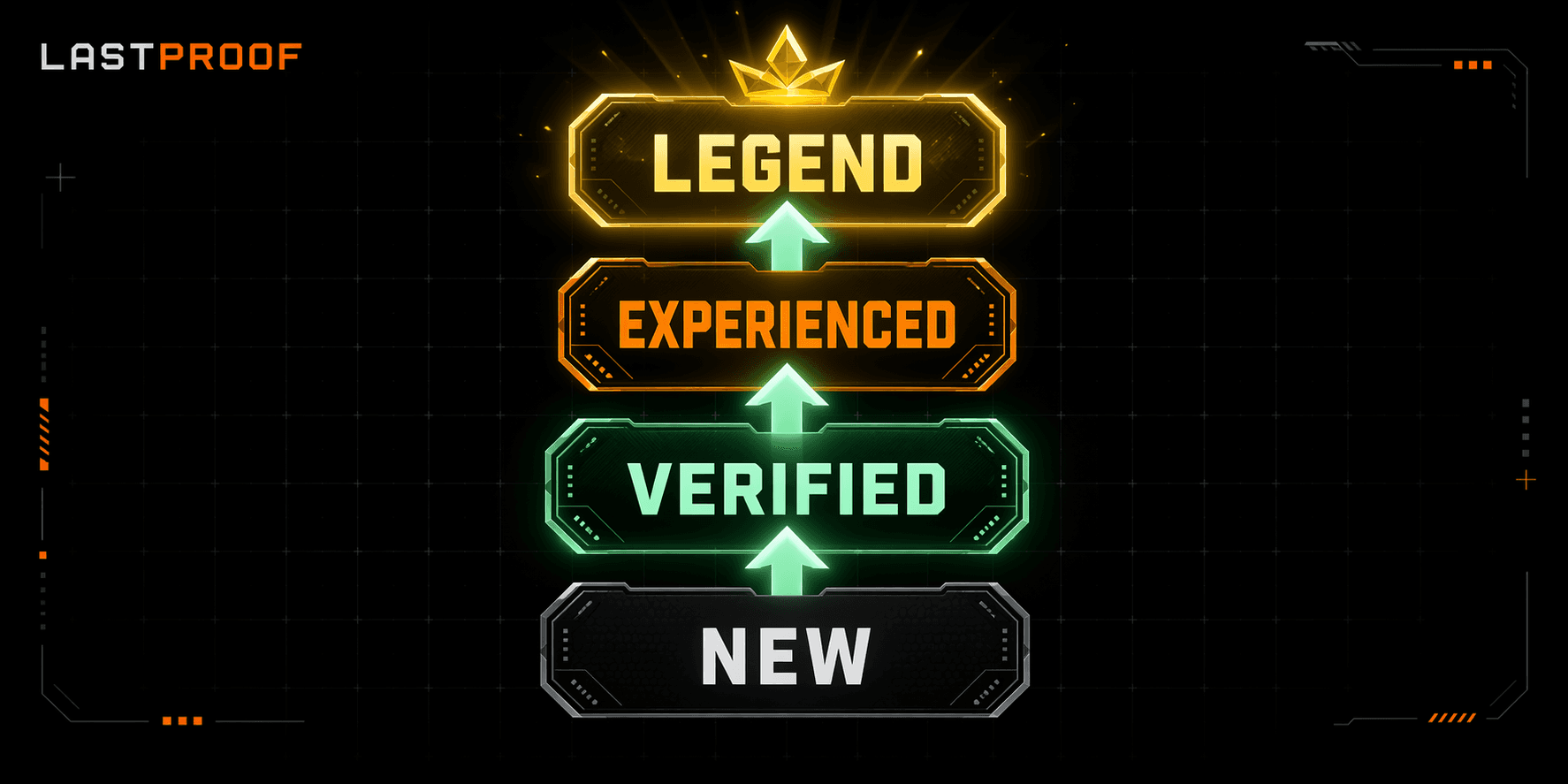
your tier badge (NEW / VERIFIED / EXPERIENCED / LEGEND), determined by your accumulated Proof of Work count.
your chad army — a row of avatars below your tier bar, each one a click-through to a separate operator who has publicly committed to backing you, with their own tier and their own army visible on their profile.
your DEV proofs — the strongest single signal — each one a paid solana transaction, click-through verifiable on solscan, posted from a wallet tied to the dev's mint authority or first-five holder list. impersonators can't fake them.
your standard proofs — paid solana transactions from other operators confirming the work.
red flags if applicable — 30+ days inactive, category sprawl, zero DEV proofs.
a vetter assembling these signals doesn't need a screenshot. the signals are independently verifiable, click-through, structural. the vetter's job in 2026 is no longer "decide whether to believe what this anon shows me" — it's "audit the chain that's already public."
screenshots become irrelevant. the only screenshot worth taking is one of the lastproof profile itself, which is just a link.
the math of vouching
a chad army of 5 high-tier operators carries more signal than a chad army of 50 randoms. here's why.
tier propagates. when a LEGEND vouches for you (clicks + ADD CHAD on your profile and you accept), that LEGEND's own track record — every DEV proof, every standard proof, every operator they themselves are vouched by — is now anchoring you. their reputation cost on a bad bet is enormous because they have so much to lose. their accept means more than 10 NEW accepts.
this is the same math as backlinks in SEO. a single link from a high-authority domain outweighs a hundred links from blog farms. social proof in web3 follows the same curve. quality compounds; quantity dilutes.
practical heuristic: 5 chads with mixed tiers, including at least one VERIFIED or above, is the threshold where chad armies start carrying real signal. below 5, the army is cosmetic. above 5 with diverse tiers, the army is structural. above 20 if all the chads are NEW, you might actually look worse, because it suggests you're farming asks rather than building real network.
builders looking at chad armies should weight tier, not count.
what to do as an operator
four things, in order.
first, claim your handle on lastproof. if you're in the first 5,000, your profile is free forever. claiming is a one-time wallet sign — no email, no kyc, your handle becomes lastproof.app/@yourhandle and it routes everywhere.
second, post your first DEV proof. ask one project dev you've worked with to post a $5 DEV proof from the wallet tied to that project's mint authority. this is the strongest single signal you can carry. it's the difference between a NEW profile and a structurally-backed one.
third, build your chad army. send + ADD CHAD asks to operators you've actually worked with — telegram mod chains, kol rotations, raid groups. send 5-10 in your first week. accept asks from operators you'd actually back. deny the rest.
fourth, hit GET FOUND on the homepage if you haven't already, so your handle surfaces in SHIFTBOT searches when devs scan The Grid for operators in your category.
same marketer. different proof. memecoins die. your reputation shouldn't.
what to do as a builder
if you're a project dev hiring an anon, the workflow gets shorter.
scan The Grid for operators in your category — SHIFTBOT filters by tier, category, recency, and proof count. shortlist 3-5.
click each shortlisted profile. look at their chad army first, before their proofs. ask: who is publicly backing this person, and what tiers do those backers carry? a chad array of 5+ with at least one VERIFIED or LEGEND is structural. an empty army or a count of 1 (just the @lastshiftfounder default) means the operator hasn't built a network yet — they may still be legit, but you have less signal.
cross-check: pick one chad in their army, click into that chad's profile, check that the relationship goes both ways for high-confidence cases. directional vouching is fine, but mutual chad relationships between two strong profiles are the strongest single inference of "these two have actually worked together and both bet on each other."
read the DEV proofs and standard proofs same as before. the chad army is additive signal, not a replacement for the underlying proof of work.
every proof is a paid solana transaction, click-through verifiable on solscan. nothing requires you to take an operator's word.
you're one bad hire away from rugged work. the chad army is the cheapest way to short-circuit that risk before you wire usdt.